Showing posts with label Electric Car. Show all posts

February 26, 2011

2011 Nissan Electric Sports Cars ESFLOW Concept

2011 Nissan Electric Sports Cars ESFLOW Concept
The ESFLOW concept cars will be unveiled at the 2011 Geneva Motor Show (3-13 March) where it will share the Nissan stand with a number of other innovative and exciting newcomers - but with one major difference: these are production ready.
The 2011 Nissan Electric Sports Cars ESFLOW Concept isn�t scheduled to be unveiled until the 2011 Geneva Motor Show in just a couple of weeks. Nissan plans to reveal its new electric concept, called Esflow, at the Chicago Auto Show this year. The car will make its world debut at the 2011 Geneva Motor Show from March.
2011 Nissan Electric Sports Cars ESFLOW Concept
Nissan has a reputation for creating some of the most exhilarating sports cars on the market. Nissan has also developed the world's first practical Zero Emission family car, the Nissan LEAF. Now Nissan has put that expertise together. It has captured the excitement of a sports car and the environmental benefits of an electric vehicle and blended them into one dramatic two-seater concept: ESFLOW.
It may be a concept, but the Nissan ESFLOW electric sports cars proves it's possible to remain environmentally sympathetic without having to give up the joy of driving. It looks like a sports car, handles like a sports car and performs like one too. But Nissan ESFLOW Concept cars is different to every other sports car yet built: it's electric. Using technology pioneered in the award-winning Nissan LEAF, the EV concept shows that driving can still be as much fun tomorrow as it is today.
2011 Nissan Electric Sports Cars ESFLOW Concept
Ecological minimalism need not come at the expense of luxury. The cabin of the 2011 Nissan Electric Sports Cars ESFLOW Concept is clean and open and weight saving has been a priority throughout its design, but it is still a comfortable and pleasant place to sit. By far the heaviest components in modern cars' interiors are the steel framed, thickly upholstered and increasingly motorized seats. In 2011 Nissan Electric Sports Cars ESFLOW Concept the seats are sculpted into the rear bulkhead of the car, negating the need for a heavy frame. This of course means that they are immobile, but this is of no consequence as the fly-by-wire steering and pedals adjust electrically to the best spot to suit each individual driver's size and preferred driving position.
Nissan ESFLOW Concept is rear-wheel drive and it runs on two motors. The car's graceful proportions allow the twin electric motors to be placed above the axis of the rear wheels, in a mid-ship position,. These motors independently control the left and right wheels, and so the torque is optimized to ensure outstanding vehicle stability and control as well as efficient power regeneration. The motors produce enough torque in an instant for it to reach a 100kph in under 5 seconds.
2011 Nissan Electric Sports Cars ESFLOW Concept
Power for the motors comes from the same laminated lithium-ion battery packs used in the Nissan LEAF, but in ESFLOW the packs are located along the axis of the front and rear wheels. This centralizes the mass of the car, and thus its rotation point, close to the driver's hips. These cleverly positioned batteries enable the car to travel over 240km on one charge.
2011 Nissan Electric Sports Cars ESFLOW Concept
The colors of this Esflow are inspired from glaciers, with highly reflective blue-tinted solidified liquid shapes. Even if this concept will not hit the production line too soon, it could be a great source of inspiration for Nissan�s future sports cars.
February 21, 2011

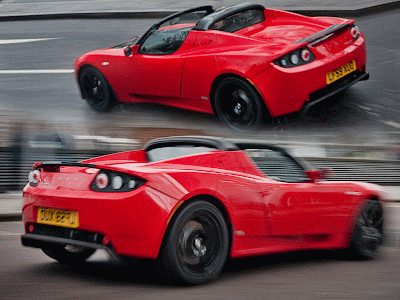
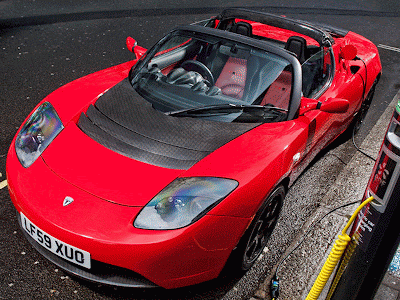
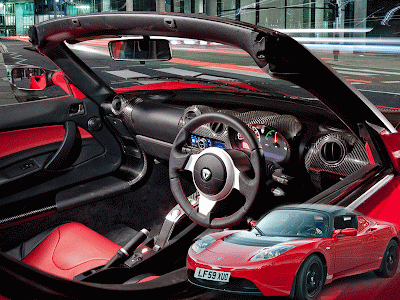
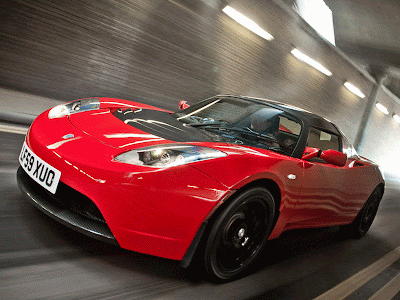
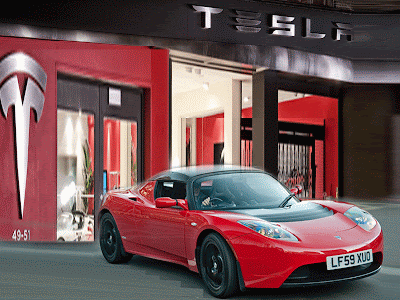
Tesla Roadster Sports Car UK-Version Electric Vehicle

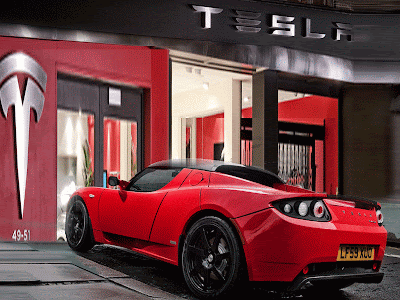
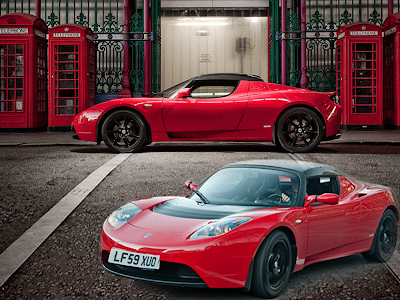
Tesla Motors has announced production of the right-hand-drive version of its iconic Tesla Roadster sports car, the only highway-capable electric vehicle for sale worldwide. The Tesla Roadster UK-Version includes a suite of unique noise-reduction materials.
Tesla Roadster Sports Car UK-Version Electric Vehicle
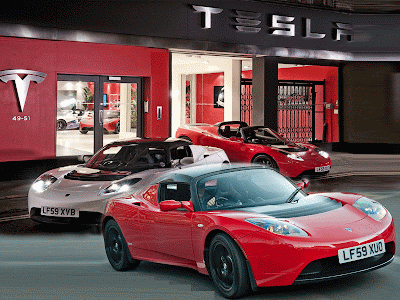
Prospective customers and media may test-drive right-hand-drive cars available at Tesla's showroom, 49-51 Cheval Place in London's Knightsbridge district (SW7 1EW). The 2010 Tesla Roadster UK-Version includes a suite of unique noise-reduction materials, an upgraded sound system and other enhancements that make it ideal for daily commuting or weekend drives.
Tesla Roadster Sports Car UK-Version Electric Vehicle
The Tesla Roadster accelerates faster than virtually any other car on the road, making it the only production car faster than a Porsche and twice as energy efficient as a Prius. It is quickly becoming the choice amongst discerning drivers who demand performance with a clean conscience.
Tesla Roadster Sports Car UK-Version Electric Vehicle
The Tesla Roadster easily travels more than 200 miles per charge in mixed driving conditions, consumes no petroleum and plugs into conventional 220-volt sockets throughout Europe. It can be fully or partially recharged by solar or wind power. A customer's Tesla Roadster recently set a world distance record for EVs with 313 miles on a single charge.
Tesla Roadster Sports Car UK-Version Electric Vehicle
"The right-hand-drive model is our response to growing demand from high-performance car buyers in the UK who are also interested in their impact on the environment," said Cristiano Carlutti, Tesla's Vice President for European Sales and Operations. "Tesla is dramatically expanding its retail footprint in Europe, we look forward to building our community of owners and fans throughout the continent."
Tesla Roadster Sports Car UK-Version Electric Vehicle
UK companies that purchase a Tesla Roadster benefit from a 100 percent Writing Down Allowance, meaning they can deduct the price of the car from their taxable profits. The Tesla Roadster is the only sports car that has ever qualified for a such a tax incentive in the UK.
Tesla Roadster Sports Car UK-Version Electric Vehicle
The Tesla Roadster starts at �86,950 and costs about 1.5p per mile, compared to as much as 32p per mile for petro-powered sports cars. Tesla Roadster drivers are do not have to pay the London congestion charge, saving up to nearly �1,700 annually. They can park for free and without time limits in various London boroughs, they get four hours of free charging at certain parking sites, and they are exempt from the forthcoming Showroom Tax of �950.

February 10, 2011

2011 Volkswagen Sports Cars XL1 (SEV) Roadster Diesel-Electric Hybrid Concept

2011 Volkswagen Sports Cars XL1 (SEV) Roadster Diesel-Electric Hybrid Concept
The latest Volkswagen will unveil the 3rd and latest iteration by its roadster diesel-electric hybrid concept serial, the fresh XL1 Super effective Vehicle (SEV) at these week�s Qatar Motor demo, which runs by January 26 to 29. The latest 2011 Volkswagen XL1 Hybrid Concept are motivated by a diminished 800 cc TDI two-cylinder basic rail diesel engine breaking 48 HP.
Vision becomes reality � Volkswagen�s �Formula XL1�Volkswagen XL1 prototype consumes just 0.9 l/100 km! Wolfsburg / Doha, 25 January 2011 - Future mobility is one of the most stimulating topics of our time. The key question here: Just how much could the energy consumption of cars be reduced if all the stops were pulled out for efficiency? There is now an answer to this question, and Volkswagen is delivering it in the form of the new XL1. Combined fuel consumption: 0.9 l/100 km. No other hybrid car powered by an electric motor / internal combustion engine combination is more fuel efficient.
2011 Volkswagen Sports Cars XL1 (SEV) Roadster Diesel-Electric Hybrid Concept
Volkswagen will build small run of XL1 plug-in hybrid in two years. �We want to go into series production with this car starting in 2013,� Volkswagen chairman Ferdinand Piech told Automotive News Europe on Tuesday at an event in Doha, Qatar, ahead of the 2011 Qatar auto show where Volkswagen unveiled an XL1 prototype. Pioneering construction techniques, an advanced plug-in hybrid drivetrain and innovative packaging all play a part in allowing the new Volkswagen XL1 Super Efficient Vehicle (SEV) to return 260 mpg on the combined cycle to set a new benchmark for vehicle efficiency.
The most efficient car in the world. The new 2011 Volkswagen Sports Cars XL1 (SEV) Roadster Diesel-Electric Hybrid Concept shows the way forward for extreme economy vehicles and clean technologies. It also demonstrates that such cars can also be fun.  The feeling when driving the XL1 is truly dynamic - not based on pure power, rather on its pure efficiency. Two examples: 1) To travel at a constant speed of 100 km/h, the prototype only needs 6.2 kW/8.4 PS � a fraction of the performance of today�s cars (Golf 1.6 TDI with 77 kW and 7-speed DSG: 13.2 kW/17.9 PS). 2) In electric mode, the XL1 needs less than 0.1 kWh (82 Wh/km) to complete a one kilometre driving course. These are record values.
Powering the 2011 Volkswagen Sports Cars XL1 (SEV) Roadster Diesel-Electric Hybrid Concept is a compact 800 cc TDI two-cylinder common rail diesel engine developing 47 hp. It's linked to an electric motor producing 27 hp, resulting in a total of 74 hp - a modest output yet more than enough when the low kerb weight of 1753 lbs (795 kg) of the vehicle is taken into account. Two-cylinder TDI uses mass production technology: The 0.8 litre TDI (35 kW/48 PS) was derived from the 1.6 litre TDI, which drives such cars as the Golf and Passat. The 0.8 TDI exhibits the same data as the 1.6-litre TDI common rail engine in terms of cylinder spacing (88 mm), cylinder bore (79.5 mm) and stroke (80.5 mm).
2011 Volkswagen Sports Cars XL1 (SEV) Roadster Diesel-Electric Hybrid Concept
In addition, the Volkswagen XL1 Concept's two-cylinder and the mass produced four cylinder share key internal engine features for reducing emissions. They include special piston recesses for multiple injection and individual orientation of the individual injection jets. The excellent, smooth running properties of the common rail engines were transferred to the two cylinder engine. within addition, a balancer shaft that is driven by the crankshaft turning at the same speed optimises smooth engine running.
When the full power of the hybrid system is engaged, the Volkswagen prototype accelerates from 0 to 100 km/h in just 11.9 seconds; its top speed is 160 km/h (electronically limited). Yet these numbers alone do not tell the whole story: Since the XL1 weighs just 795 kg, the drive system has an easy job of propelling the car. When full power is needed, the electric motor, which can deliver 100 Newton metres of torque from a standstill, works as a booster to support the TDI engine (120 Newton metres torque). Together, the TDI and E-motor deliver a maximum torque of 140 Newton metres in boosting mode.
2011 Volkswagen Sports Cars XL1 (SEV) Roadster Diesel-Electric Hybrid Concept
Carbon fibre reinforced polymer (CFRP) the ideal material for the body of the new 2011 Volkswagen Sports Cars XL1 (SEV) Roadster Diesel-Electric Hybrid Concept because of its light weight. The 2011 Volkswagen Sports Cars XL1 (SEV) Roadster Diesel-Electric Hybrid Conceptweighs only 795 kg. Of this figure, 227 kg represents the entire drive unit, 153 kg the running gear, 80 kg the equipment (including the two bucket seats) and 105 kg the electrical system.
That leaves 230 kg, which is precisely the weight of the body - produced largely of CFRP - including wing doors, front windscreen in thin-glass technology as in motorsport and the highly safe monocoque. A total of 21.3 percent of the new Volkswagen XL1, or 169 kg, consists of CFRP. In addition, Volkswagen uses lightweight metals for 22.5 percent of all parts (179 kg). Only 23.2 percent (184 kg) of the new XL1 is constructed from steel and iron materials. The rest of its weight is distributed among various other polymers (e.g. polycarbonate side windows), metals, natural fibres, process materials and electronics.
2011 Volkswagen Sports Cars XL1 (SEV) Roadster Diesel-Electric Hybrid Concept
Design for a new era: The VW XL1 is 3,888 mm long, 1,665 mm wide and just 1,156 mm tall. These are extreme dimensions. The Polo has a similar length (3,970 mm) and width (1,682 m), but it is significantly taller (1,462 mm). The height of the new 2011 Volkswagen Sports Cars XL1 (SEV) Roadster Diesel-Electric Hybrid Concept is about the same as that of a Lamborghini Gallardo Spyder (1,184 mm). So, it is easy to visualise just how spectacular such a Volkswagen would appear on the road � as long and wide as a Polo, but with a low profile like a Lamborghini.
The styling of the 2011 Volkswagen Sports Cars XL1 (SEV) Roadster Diesel-Electric Hybrid Concept is borne out of functional requirements - easy access to the interior is granted via a pair of elegant scissor doors that hinge on the A-pillar while the profile of the car has been honed in the wind tunnel, the result being a remarkable coefficient of drag figure of 0.186. The XL1's overall length and width are similar to those of a Volkswagen Polo yet its height is more akin to that of a Lamborghini Gallardo Spyder.
Although the 2011 Volkswagen Sports Cars XL1 (SEV) Roadster Diesel-Electric Hybrid is still very much a concept, its unveiling marks the next step towards the birth of a new class of Super Efficient Vehicles, while the advent of a process such as RTM is a significant milestone.

February 3, 2010

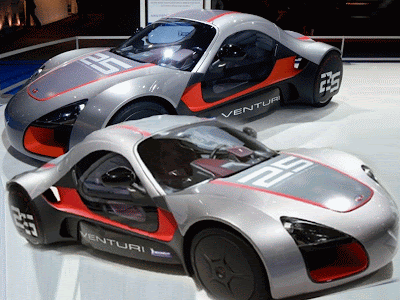
Venturi Electric Sports Car Volage Concept

Venturi Electric Sports Car Volage Concept

The result of close technological collaboration between Venturi Automobiles and Michelin, the Venturi Volage, marks a major step forward in the evolution of the Automobile. This new Venturi incorporates innovations which have enabled radical changes in terms of the vehicle’s architecture, style, dynamic behaviour and, more generally, the design of a modern vehicle. All these changes constitute several world premières which, with the presentation of the Venturi Volage, reinforce Venturi’s capability for constant innovation, as well as its position as the most advanced company in the field of electric vehicles.
Venturi Electric Sports Car Volage Concept

The Volage takes the electric sports car concept and really runs with it — the all carbon-fiber car is equipped with the first application we've seen of the Michelin Active Wheel, the compact unit using in-wheel electric drive motors is installed at all four corners with a suspension driven by a second set of e-motors. With 4 drive wheels with active suspension, the Venturi Volage has no equivalent. “Michelin Active Wheel” technology in fact incorporates 2 electric motors per wheel (1 for suspension and 1 for drive), ie. a total of 8 electric motors piloted in real time by spearhead electronics.
Venturi Electric Sports Car Volage Concept

Playing down the mechanical aspect in favor of electronics, close to the concept of a robot, this car belongs to a new era, the digital era. Thanks to a dashboard touch screen, the driver can configure the vehicle entirely as he wishes. This total control marks significant progress in terms of management, particularly of the energy stored in the car’s batteries: the driver can, for example, decide to give preference in certain cases to range rather than power, comfort rather than speed, an important factor for an electric car.
Venturi Electric Sports Car Volage Concept

The only part that the Venturi Volage shares with the Venturi Fétish is its carbon fiber bodywork. Developed by the Venturi Design Office, this body is still a unique concept worldwide, as it is the only one to have been specifically designed to be that of an electric car and thus carry batteries within its very structure. The ideal distribution of the Venturi Volage’s masses - 45% at the front, 55% at the rear – and its perfectly mastered weight of 1,075 kilos enable it to attain 100 km/hr (62 mph) in less than 5 seconds.
Venturi Electric Sports Car Volage Concept

A real demonstration of spearhead technology, the car presented in its world première is entirely operational and prefigures the production of a limited series of this model, scheduled as from 2012. Like the Venturi Fétish assembled in our workshops in Monaco, the Venturi Volage will be assembled by hand, in the form of very limited production. 
Venturi Electric Sports Car Volage Concept

The technological repercussions of these two cars positioned at the very top end of the market are to be found on other vehicles bearing the Venturi brand, enabling as many people as possible to benefit from the firm’s advances in the field of sustainable mobility.

Venturi Electric Sports Car Volage Concept

Venturi Electric Sports Car Volage Concept

The result of close technological collaboration between Venturi Automobiles and Michelin, the Venturi Volage, marks a major step forward in the evolution of the Automobile. This new Venturi incorporates innovations which have enabled radical changes in terms of the vehicle’s architecture, style, dynamic behaviour and, more generally, the design of a modern vehicle. All these changes constitute several world premières which, with the presentation of the Venturi Volage, reinforce Venturi’s capability for constant innovation, as well as its position as the most advanced company in the field of electric vehicles.
Venturi Electric Sports Car Volage Concept

The Volage takes the electric sports car concept and really runs with it — the all carbon-fiber car is equipped with the first application we've seen of the Michelin Active Wheel, the compact unit using in-wheel electric drive motors is installed at all four corners with a suspension driven by a second set of e-motors. With 4 drive wheels with active suspension, the Venturi Volage has no equivalent. “Michelin Active Wheel” technology in fact incorporates 2 electric motors per wheel (1 for suspension and 1 for drive), ie. a total of 8 electric motors piloted in real time by spearhead electronics.
Venturi Electric Sports Car Volage Concept

Playing down the mechanical aspect in favor of electronics, close to the concept of a robot, this car belongs to a new era, the digital era. Thanks to a dashboard touch screen, the driver can configure the vehicle entirely as he wishes. This total control marks significant progress in terms of management, particularly of the energy stored in the car’s batteries: the driver can, for example, decide to give preference in certain cases to range rather than power, comfort rather than speed, an important factor for an electric car.
Venturi Electric Sports Car Volage Concept

The only part that the Venturi Volage shares with the Venturi Fétish is its carbon fiber bodywork. Developed by the Venturi Design Office, this body is still a unique concept worldwide, as it is the only one to have been specifically designed to be that of an electric car and thus carry batteries within its very structure. The ideal distribution of the Venturi Volage’s masses - 45% at the front, 55% at the rear – and its perfectly mastered weight of 1,075 kilos enable it to attain 100 km/hr (62 mph) in less than 5 seconds.
Venturi Electric Sports Car Volage Concept

A real demonstration of spearhead technology, the car presented in its world première is entirely operational and prefigures the production of a limited series of this model, scheduled as from 2012. Like the Venturi Fétish assembled in our workshops in Monaco, the Venturi Volage will be assembled by hand, in the form of very limited production. 
Venturi Electric Sports Car Volage Concept

The technological repercussions of these two cars positioned at the very top end of the market are to be found on other vehicles bearing the Venturi brand, enabling as many people as possible to benefit from the firm’s advances in the field of sustainable mobility.

October 3, 2009

New Small Car from Mitsubishi

New Small car is now in heavy demand and that's why big player like Mitsubishi Motors also launching there small cars. Speciality about this small car is that its run on electricity.

Few special features about this new small car is -
  1. Fuel tank replaced by advanced version of lithium-ion battery
  2. Have the 4 seating capacity
  3. This one is eco friendly.